
YOUR SPICE TOLERANCE IS KILLING YOUR BRAND
Standing out is meant to be uncomfortable. A creative’s idea of standing out, and a client’s idea of standing out, are two very different things. Turns out, we're not all working with the same spice tolerance.
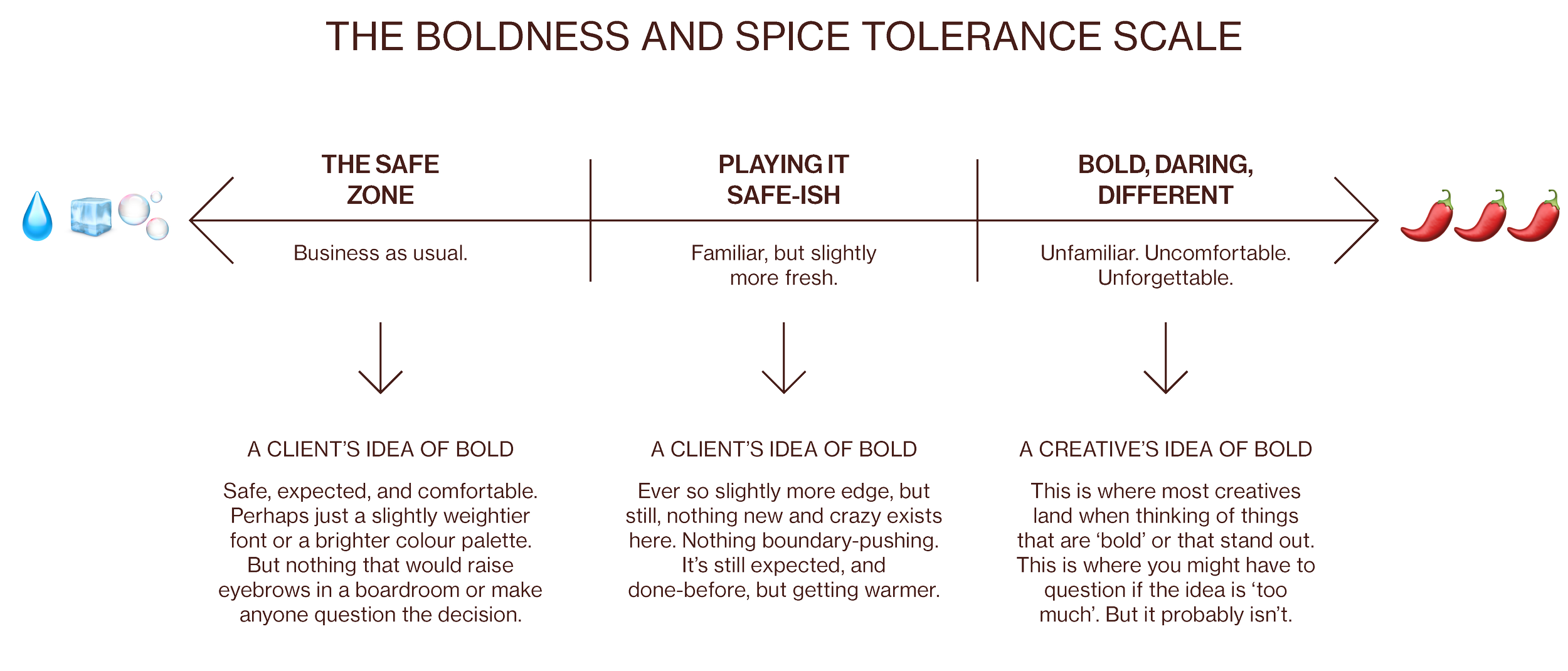
Everyone says they want to stand out. And to be bold. And that they want to cut through the noise.
But there’s a big, huge, gaping gap between a creative’s idea of standing out, and a client’s idea of standing out. Because very few clients actually mean ‘standing out’ in the same sense that us creatives mean it. Which means most of the time, we’re actually both not even talking about the same thing.
It’s a bit like spice tolerance. I love a medium spice, but there are some people out there who think toothpaste and soda water are spicy. And some people who simply can’t handle having a sip of water after having a mint. You know what I mean?
But whether it’s toothpaste or a jalapeño, we both still call it spicy. Because we both have different spice tolerances for it. Your mild could be their extra hot. And their extra hot could be your medium.
It seems like our tolerance for boldness and standing out works the same way.
When I talk about things ‘standing out’ or being ‘bold’, I mean this in a way that really challenges our expectations, and challenges what we think we know, and the things we’ve seen before. I mean the kinds of ideas that feel unfamiliar at first because they are unfamiliar. I’m sure many other creatives would land in this space too.
But when clients talk about standing out, they often don’t realise there is a limit to the boldness they’d actually feel comfortable going with, and in reality what they’re really looking for is something much milder.
When most clients talk about standing out and being bold, what they are actually looking for is familiar, but just ever so slightly braver than before. And just a little bit spicier than last time.
This is when it can turn into a bit of a challenge between creative and client, because at the beginning of a project everyone agrees: let’s push the boundaries and do something bolder.
Time after time, it’s established at the start of the project that the client wants to push the boundaries and do something different. Yet very often when creatives put forward ideas that tick this box, the team will say “Well… actually… we don’t want to be that bold”.
Because we never stopped to check that we’re both pointing at the same spot on the scale, everyone walks away from the initial conversation thinking they’re aligned. But under the surface, the creative is working on something with the spice levels of Sriracha, while the client is expecting something more like a mild salsa.
So the ideas and concepts that get labelled as ‘too much’, ‘too abstract’, or ‘too risky’ aren’t actually that extreme at all. They’re just unfamiliar. And unfamiliar is where most brands feel uncomfortable. And uncomfortable = no go.
But we all need to get more comfy in this uncomfy-ness. The irony is, this discomfort is usually the very thing that shows you you’re onto something.
Bold work always feels risky before it feels right. It’s meant to challenge you. It’s meant to make you question if it’s ‘too much’. Standing out is meant to be uncomfortable.
So if your tolerance for boldness is still very mild, anything with actual depth, flavour, and spice, is going to feel like too much of a leap.
How many people do you reckon flagged Liquid Death’s brand name prior to launch and said “Wait, you can’t have a product name with ‘death’ in it”. But look at the company now. They’re currently valued at $1.4 billion. Yes, billion with a B.
Being bold, challenging the norm, and standing out can have its risks. But how often have you seen campaigns and copylines and think ‘It’s so epic that got approved’. And those are always the ones that you remember.
If I can leave you with one piece of advice, have the guts to go for something bolder than you feel comfortable doing. Chances are, your business will thank you for it.