
THE BEST BRAND NAMES GO UNNOTICED
Yes, you read that right.
Get your brand name really right, and people will never really question it.
I bet you’ve probably never stopped to think that Virgin Airlines is in fact called Virgin. And if you have, it probably took a while before you thought ‘hang on a second…’.
I can only imagine being a fly on the wall during the naming conversations, filled with comments like “but we can’t call ourselves THAT!”
But have a ‘safe’ brand name, and people won’t question it either.
Does anyone know what ‘Coles’ means? Or ‘Woolworths’? I’m just assuming these are family names, but really, who knows. There’s no descriptive connotations to supermarket shopping, or tone of voice in there to tell us otherwise. Or what about Adairs? Or Bega? These are all big household names in Australia, yet none of them really say a whole lot.
But get your brand name wrong, and it’ll stick for all the wrong reasons.
For those who were paying attention in 2019, you might remember that when Skims initially launched, it was actually called Kimono, which quickly sparked backlash over cultural appropriation. It’s an absolute shocker that no one on their team picked up on this prior to launch, but that’s a conversation for another day.
Quite obviously, a bad name will always do more harm than an average name.
But an incredible name often goes more unnoticed than an average one.
Which if you ask me is very upsetting, because bad names should never make the cut in the first place, but unfortunately they do.
And when those mediocre and ‘safe’ names get approved (Coles, Woolworths, Adairs), prove to work at scale, and become household names, there’s less motivation to think outside the box and push brand names to be better, and to do more.
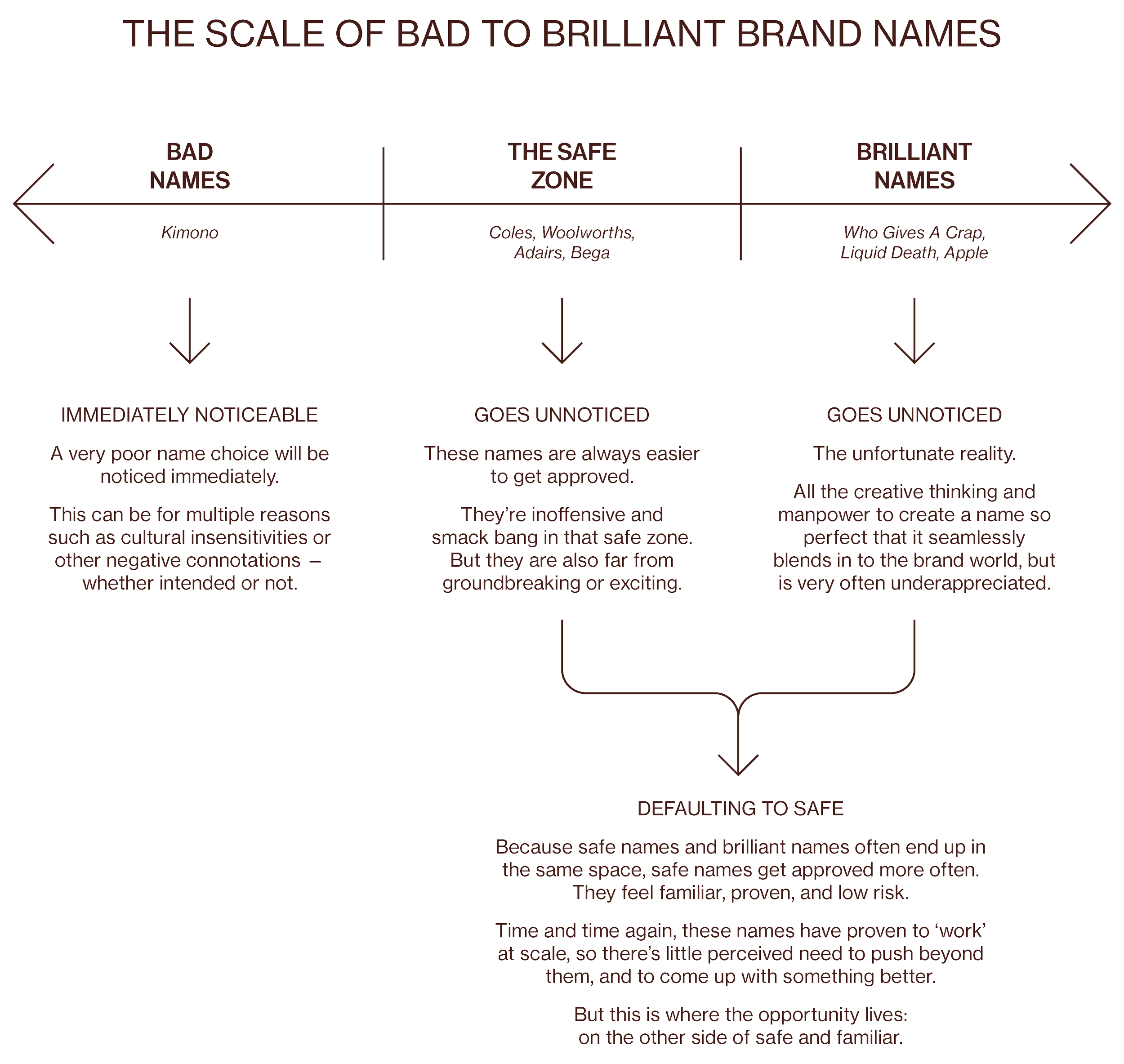
And there is so much opportunity available for us to live in a world with much more interesting brand names. And if you manage to get your name really right, it should simply blend in to the entirety of your brand world.
Here are a few of my fave examples of this:
Slather: An Aussie sunscreen brand shaking up the industry. For a sunscreen brand targeted at men, they’ve perfected the tone of the brand in a single word, with it making perfect sense for slathering on sunscreen. It says exactly what they do and what they stand for, without saying it at all. A little bit like an onomatopoeia, if you will.
Liquid Death: Ahh, yes, associating a drink with death. What could possibly go wrong? Well, according to the brand being valued at approximately $1.4 billion - nothing actually.
Who Gives A Crap: A toilet paper brand that actually do give a lot of craps. Like Slather, their name tells you exactly who they are, without ever using the words “toilet” or “paper”.
Apple: This is an example I always give with my clients. Because the obvious reaction here during initial conversations would be “but we’re a technology company, what’s an apple got to do with that?” or “an apple doesn’t explain that we sell tech?” Meanwhile Apple proceeds to be one of the most iconic and influential companies we know today.
But I’m a brand designer talking. And like any good designer, these finer details are the things I notice like a deer in headlights. So for the average Joe, the right brand name should feel so right that it almost goes unnoticed, without a second thought. Most people will simply just accept that Apple is called Apple, without ever questioning it.
And while every Aussie will be familiar with names like Coles, Woolworths, and Adairs, these names don’t really say much. They’re in that middle area. The safe zone. They don’t have any associations around what these brands offer, and more importantly they don’t communicate any brand persona.
And that’s the difference between an average name and a brilliant one.